
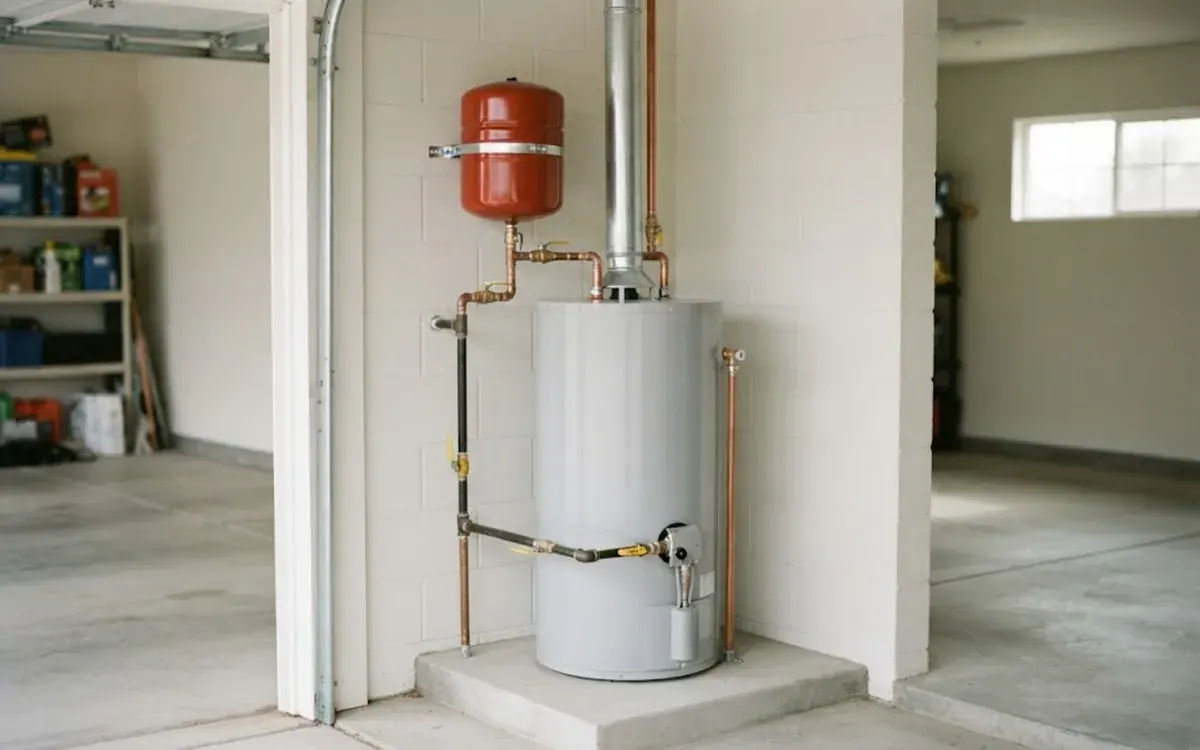
A tank water heater is a steel tank with a protective lining, a heat source and a few valves. Over years, the lining wears, sediment builds and parts weaken. Eventually, the tank leaks, and a leak from the tank body cannot be repaired.
The goal is to replace it before that happens. Here are the signs to watch, how to find your heater's age and how to plan a replacement on your own timeline.
Find the age of your heater
The serial number on the label includes the manufacture date. The format varies by brand. Many use a letter for the month and two digits for the year, such as a serial beginning with a letter followed by the year. Search the brand's guide or ask us to read it.
As a rough rule, tank heaters run about ten years, sometimes more with good care. A heater past that age is living on borrowed time, even if it still works.
Signs the heater is near the end
Rusty hot water
Rust-colored water from the hot tap only, and not the cold, points to a corroding tank.
Rumbling or popping
Sediment at the bottom traps water that flashes to steam.
Moisture at the base
Even a few drops can mean the tank is seeping. A tank leak cannot be patched.
Running out of hot water
A failed element or heavy sediment reduces capacity. Repair is possible, but age changes the math.
If a leak is already happening, close the cold supply to the tank and call. That is an emergency, and see our page on emergency water heater replacement.
Want an honest opinion on your heater?
Call and a plumber will look at it.
Repair or replace
| Situation | Usual decision | Why |
|---|---|---|
| Under 8 years, a failed part | Repair | The tank is sound |
| 10 to 12 years, one repair needed | Compare costs | A repair may buy only a short time |
| Over 12 years | Plan a replacement | Failure risk is high |
| Leak from the tank | Replace | Tank cannot be repaired |
Planning a replacement
Check the tag
Note the size, fuel and age.
Decide on type
Stay with a tank, or consider tankless or hybrid.
Check the space
Venting, clearance and drainage.
Schedule it
Book a visit in daytime and avoid the emergency premium.
How to extend the life of a heater you keep
- Flush the tank once a year to remove sediment.
- Check the anode rod every few years.
- Set the temperature to about 120 degrees.
- Test the relief valve once a year.
- Keep the area around the heater clear.
The cost of waiting
A water heater that fails while you are asleep or at work can release a full tank into the house. Cleanup, drying and repair of floors and walls often cost more than the heater. Replacing early turns an uncontrolled event into a scheduled one.
There is also the question of timing. A planned replacement can be done in daylight, with a choice of models. An emergency replacement is done with whatever is available.
What happens on replacement day
Shut off and drain
Water, gas or power are shut off and the old tank is drained.
Remove and set
The old tank is removed and the new one is placed on a pan or platform.
Connect
Water, gas or electric, venting and the relief valve are connected.
Fill and test
The tank is filled, checked for leaks and brought to temperature.
Tank size and type: a quick guide
| Household | Common tank size | Note |
|---|---|---|
| One or two people | 30 to 40 gallons | Check the first-hour rating |
| Three to four people | 40 to 50 gallons | Most common choice |
| Five or more | 50 to 75 gallons or tankless | Heavy simultaneous use |
The first-hour rating, printed on the label, tells you how much hot water the heater can deliver in an hour starting with a full tank. It is a better guide than the tank size alone, because a high-recovery heater can serve a larger household from a smaller tank.
Signs to watch between replacements
Check the heater at the start of each season. Look for damp spots, rust streaks and corrosion on the fittings. Put a hand near the relief valve pipe and look for any trace of water. Catching a small seep early gives you time to plan a replacement instead of reacting to a flood.
Codes and licensing to know about
Plumbing in California is governed by the California Plumbing Code, which is based on the Uniform Plumbing Code (UPC). Whether a project like this needs a permit depends on the scope, so ask the City of Lemon Grove building department before you start. Contractors hold a C-36 plumbing license from the Contractors State License Board, which you can verify at cslb.ca.gov.
Plumbing in Lemon Grove: local notes
Helix Water District supplies Lemon Grove, and mineral content in water affects how quickly sediment builds. We do not quote a hardness figure. Ask Helix for its annual water quality report, or test your tap, and set the flush schedule to match.
Before a replacement, ask the City of Lemon Grove building department which permit applies. Many water heaters sit in garages, so also check that straps are tight and the gas flex line is in good condition.
Frequently asked questions
Roughly a decade, sometimes longer.
Yes. The serial number includes it, in a code that varies by brand.
A leak at a fitting can be repaired. A leak from the tank body cannot.
Often, if the space allows. We measure and advise.
Permit rules vary, so ask the City of Lemon Grove building department which apply to your address. We plan the job around what the city says.