
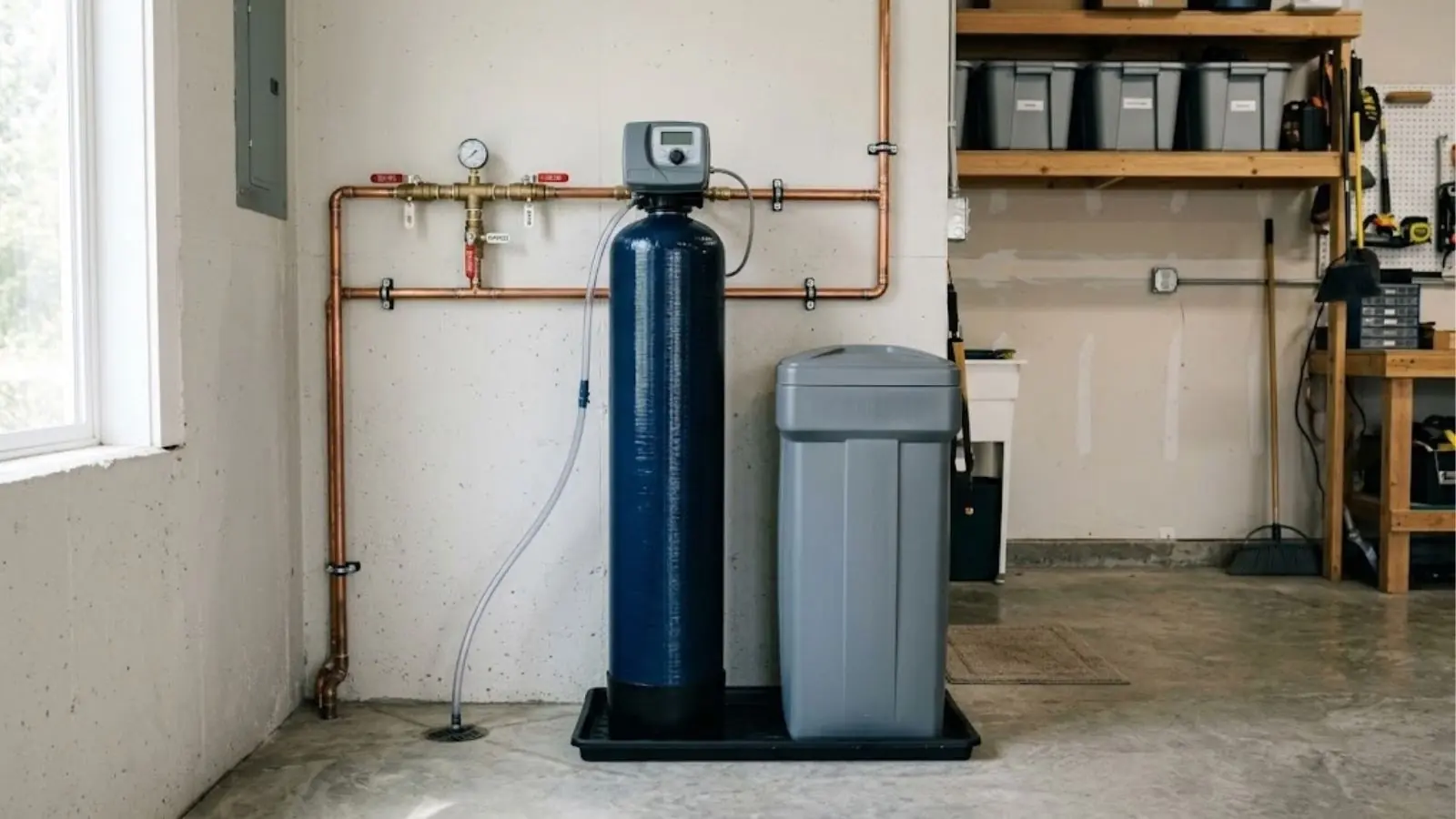
A water softener is a pair of tanks. One holds resin that swaps hardness minerals for sodium or potassium. The other holds salt brine that recharges the resin. The unit connects to your water line, to a drain and to a power outlet.
Installing one yourself is possible if you are comfortable with soldering or push fittings, cutting pipe and testing for leaks. Many homeowners are, and many are not. The question is what happens if something goes wrong.
What the job involves
Choose the location
Near the main water line, a drain and an outlet, usually the garage.
Shut off and drain
Close the main valve, open a tap to drain the line and cut into the pipe.
Install the bypass
A bypass valve lets you isolate the unit. It connects to the inlet and outlet of the softener.
Connect the drain line
A drain hose needs an air gap and a proper discharge point.
Program and test
Set hardness, regeneration time and salt level. Check every joint for leaks.
Where DIY goes wrong
Leaks
One badly soldered joint can leak inside a wall or on a garage floor and no one notices for weeks.
Inlet and outlet reversed
Water flows backward and the unit does not soften.
Drain problems
An improper drain can back up or siphon.
Wrong setting
Sizing and hardness settings affect salt use and water quality.
Prefer a plumber to do it?
Call and describe your garage and your main line.
DIY or hire a plumber
DIY may work if
- You are comfortable cutting and joining pipe.
- The unit comes with a bypass and clear instructions.
- You have a nearby drain and outlet.
- You can test your water first.
Hire a plumber if
- You will cut copper and need to solder.
- The main line is hard to reach.
- You are unsure of your hardness or sizing.
- You rent and need an approved installer.
Test first, whoever installs it
A softener without a hardness test is a guess. Test the water with a kit or ask your utility for its report. The result decides what size the unit needs and how to set it.
If your concern is taste or chlorine, a softener is the wrong tool. A carbon filter handles that. See our water softener and filtration page to understand the difference.
Rules and permits
Some cities limit where softener brine can be discharged. Ask the City of Lemon Grove and your sewer provider whether any local rule applies. We do not assume the answer. Plumbing work can also need a permit, which the building department can confirm.
Salt and maintenance after the install
A softener needs salt, and the amount you use depends on the hardness and your water use. Check the brine tank once a month, break up any salt crust and refill when it drops below about a third.
Use salt made for softeners. Some units use potassium instead of sodium, at a higher price. The resin also wears out after many years and may need replacement.
Sizing the unit
Softeners are sized by how many grains of hardness they can remove before they need to regenerate. A household with high hardness and many people needs a larger unit than a single person with moderate hardness. A unit that is too small regenerates too often and wastes salt and water.
Using the bypass
The bypass valve lets water skip the softener. You use it during service or when you do not want softened water, for example when watering a garden. Learn how it works during the install so you are not hunting for it later.
A realistic view of the time and tools
A first-time installer should plan a full day. Gather the pipe, fittings, a bypass valve, a drain hose, a tubing cutter, plumber's tape and a few spare parts before you shut the water off. A last-minute trip to the store while the house has no water is the usual source of stress.
If you plan to solder, practice on scrap pipe first and keep a spray bottle of water nearby as a safety measure. If you plan to use push fittings, make sure the pipe ends are cut square and clean. Most leaks in a first install come from rushed pipe preparation.
After the install: check again
Check every joint for drips immediately and again the next day. Look at the drain connection while the unit regenerates. A small leak that you catch on day two is a nuisance. The same leak found a month later is damage.
Codes and licensing to know about
Plumbing in California is governed by the California Plumbing Code, which is based on the Uniform Plumbing Code (UPC). Whether a project like this needs a permit depends on the scope, so ask the City of Lemon Grove building department before you start. Contractors hold a C-36 plumbing license from the Contractors State License Board, which you can verify at cslb.ca.gov.
Plumbing in Lemon Grove: local notes
Helix Water District supplies Lemon Grove. We do not state a hardness number here, because Helix publishes an annual water quality report that is the right source. Download it before you buy a softener and size the unit to the number it gives.
Nearly half of Lemon Grove homes are rented, based on 2020 Census figures. If you rent, a softener is the owner's decision and the owner's equipment. Ask before you buy or install anything.
Frequently asked questions
Ask the City of Lemon Grove building department. Rules vary.
A day for a first-timer, sometimes more.
Yes. A small outlet runs the control head.
Pipe cutter, fittings, a torch or push fittings, tape and a drain hose.
Only with the owner's approval. A softener changes the plumbing and may leave the owner with equipment. Ask in writing first.