
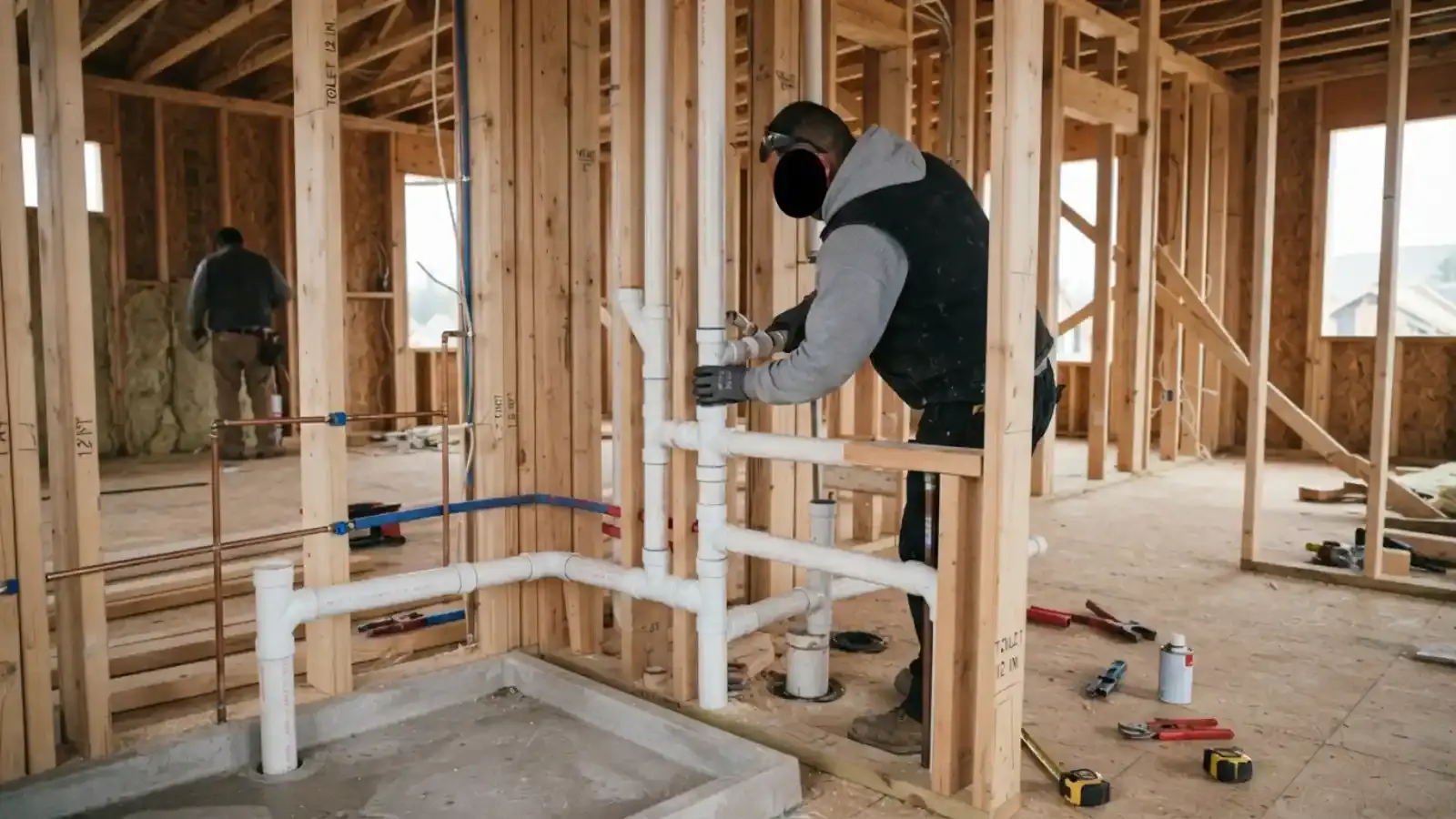
A house has two plumbing systems. The supply system brings pressurized water in from the street. The drain-waste-vent system carries wastewater out by gravity and keeps sewer gas from entering the home. They meet only at fixtures, where a faucet or a showerhead releases supply water and a drain takes the used water away.
Understanding that split explains why some problems affect only hot water, why some affect only drains and why a leak on one side never looks like a leak on the other.
The supply side
The meter
Water passes through a meter at the street. It belongs to the water utility.
The main valve
After the meter, a shutoff valve lets you stop water to the house.
The pressure regulator
Many homes have a valve that lowers street pressure to a safe level.
Branch lines
Pipes split to the water heater and to each fixture, usually with a cold and a hot line.
The water heater adds the hot side. Cold water enters the tank and leaves heated. The pipe pattern is cold on one side and hot on the other at every fixture.
The drain, waste and vent side
Every drain has a trap, a curved section that holds water and blocks sewer gas. Drains slope downward to larger pipes and join the main sewer line, which leaves the house toward the street.
Vents are pipes that rise through the roof. They let air into the drain system so water flows freely and traps do not siphon dry. A blocked vent can make drains gurgle or drain slowly.
| System | Pressure | Flow | Main materials |
|---|---|---|---|
| Supply | Pressurized | Any direction | Copper, PEX, CPVC, galvanized |
| Drain | Gravity | Downhill | ABS, PVC, cast iron, clay |
| Vent | Atmospheric | Air in | ABS, PVC, cast iron |
Curious what is in your walls?
Call and a plumber can explain what your house has.
Where problems show up
Supply leaks
Stains, low pressure, high bills and wet spots. Water runs even when nothing is open.
Drain clogs
Slow drains, gurgling and backups. The problem is always below the fixture.
Vent problems
Gurgling, slow drains in several fixtures and sewer smells.
Heater trouble
No hot water, rust-colored hot water or leaks at the base.
Things every homeowner should know
- Where the main water shutoff is.
- Where the cleanout is.
- Where the water heater shutoffs are.
- How old the pipes are.
- Who maintains the sewer line past your property.
If you can name those five things, you are ahead of most homeowners. If you cannot, a plumber can walk the house with you in an hour.
Gas lines and venting, the other pipes
Gas appliances such as a water heater, a furnace and a range have a third set of pipes. Gas lines carry fuel to the appliance, and vent pipes carry exhaust to the outside. They are not part of the water plumbing, but a plumber often installs them.
Gas work needs care and a permit in most places. If you ever smell gas, leave the building and call 911 or your gas utility from outside. Do not look for the leak yourself.
Shutoffs at every fixture
Each sink, toilet and appliance should have its own shutoff valve. Those small valves let you repair a faucet or a toilet without closing the whole house. If your fixtures do not have them, adding them is one of the best small upgrades a plumber can do.
Why old houses differ from new ones
Older homes may have galvanized steel supply pipes and cast iron or clay drains. Newer homes use copper, PEX and plastic. The materials age differently and fail differently, which is why a plumber asks the age of the house when you call. Knowing the age gives a clue to the problem before anyone opens a wall.
A walk through the house
Start at the street and follow the water. It passes the meter, enters the house, meets the main valve and the regulator, and splits into branches. Follow the cold line to the water heater. From there, hot water leaves on its own branch. At each fixture, supply meets drain.
Now follow the waste. Water goes down the drain, through the trap, into a branch and then into the main drain. The vent rises beside it to the roof. A good plumber can trace every pipe in the house the same way.
A short glossary
- Angle stop: the small valve under a sink or behind a toilet.
- P-trap: the curved pipe under a sink that holds a water seal.
- Cleanout: a capped pipe used to clear a drain.
- Regulator: a valve that lowers street pressure for the house.
- Aerator: the small screen at the end of a faucet.
Codes and licensing to know about
Plumbing in California is governed by the California Plumbing Code, which is based on the Uniform Plumbing Code (UPC). Whether a project like this needs a permit depends on the scope, so ask the City of Lemon Grove building department before you start. Contractors hold a C-36 plumbing license from the Contractors State License Board, which you can verify at cslb.ca.gov.
Plumbing in Lemon Grove: local notes
Helix Water District supplies Lemon Grove and its meter marks the end of the district's responsibility on the supply side. On the drain side, the line from your house to the public sewer is generally yours, and the City of Lemon Grove public works office can tell you who maintains the main. Ask before you assume.
If you are curious how old your plumbing is, the age of the house helps. Lemon Grove was subdivided in 1892 and has grown across the decades since. Homes of several eras sit side by side, and pipes follow suit.
Frequently asked questions
A curved pipe that holds water to block sewer gas.
Vents let air into the system so drains flow and traps stay full.
An access point in the drain line, usually capped, used to clear clogs.
The supply side. It heats water that is already under pressure.
Helix Water District supplies Lemon Grove, La Mesa, El Cajon and parts of Spring Valley. Ask Helix for its annual water quality report to learn about its sources and test results.