
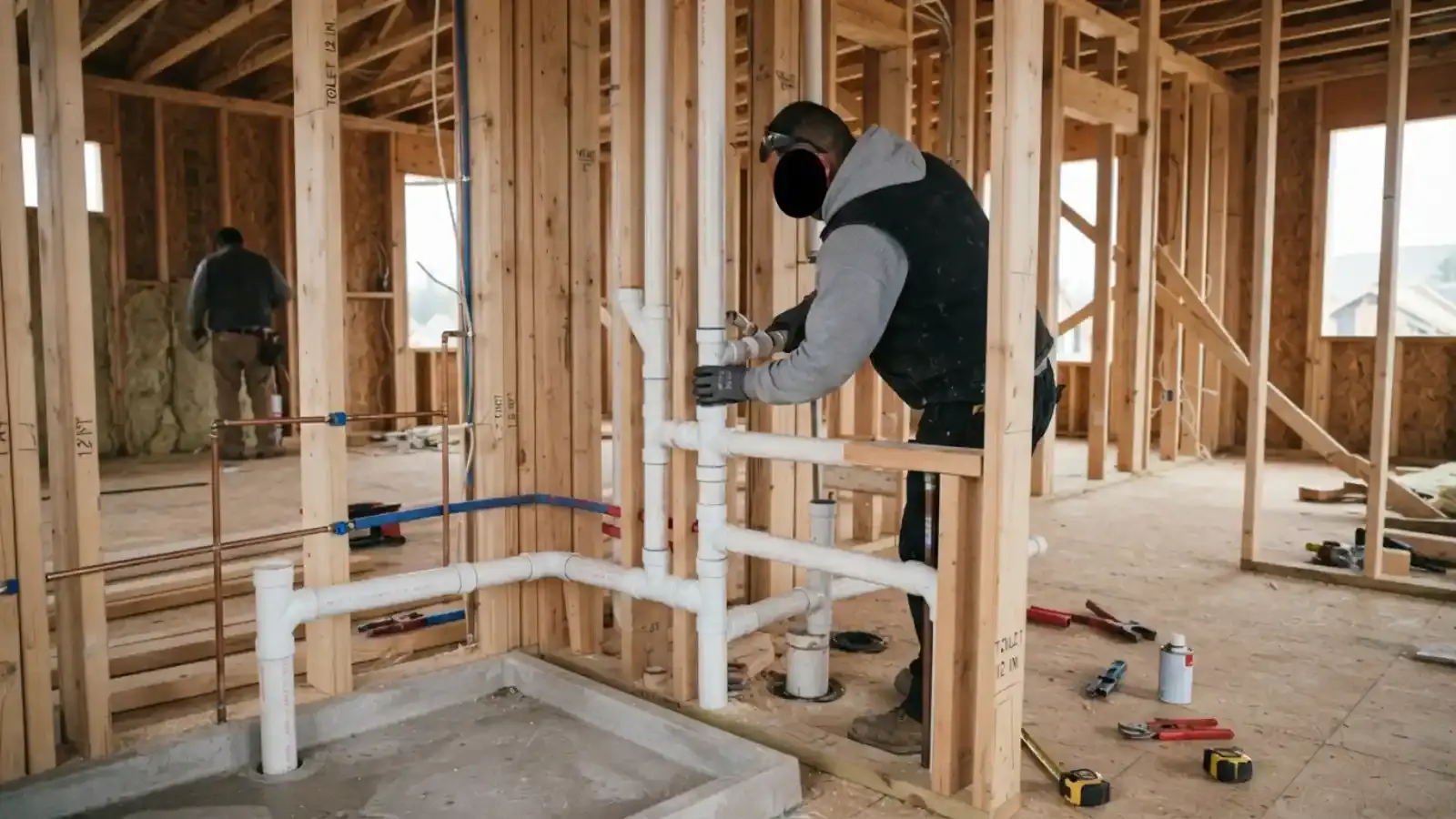
Plumbing problems fall into a handful of groups: water that will not leave, water that will not stay put, water that is too hot, too cold or too weak, and noises that should not be there. Knowing which group you are in tells you what to check first.
The list below covers the problems that most households meet, with a short fix you can try and a clear sign that it is time to call.
Water that will not leave
Slow drains are the most frequent complaint. A single slow sink usually has hair, soap or grease in the trap. A plunger or a hand snake often fixes it. If several fixtures slow down together, the main line is the suspect, and a plunger will not help.
See drain cleaning for how we clear them, and sewer line cleaning for the main line.
Water that will not stay put
Dripping faucet
A worn cartridge or washer. Replace the part. A steady drip wastes a lot of water.
Running toilet
A bad flapper or fill valve. Both are cheap and quick to replace.
Wet cabinet
A loose supply line or a failed trap connection. Dry the area and tighten or replace the part.
Stain on a ceiling
Water from above. Shut off the supply to the room above and call a plumber.
Water that is too hot, too cold or too weak
| Problem | Common cause | First check |
|---|---|---|
| No hot water | Failed element, thermostat or burner | Breaker, pilot light, reset button |
| Not enough hot water | Sediment or undersized tank | Flush the tank, check the dip tube |
| Low pressure everywhere | Partly closed main valve or failing regulator | Open the main fully, check meter side |
| Low pressure at one fixture | Clogged aerator or shower head | Soak in vinegar |
| Rust-colored water | Corroding steel pipe | Run the tap, call if it persists |
Problem not on the list?
Call and describe the symptoms.
Noises that should not be there
Banging when a tap shuts off is water hammer, which a plumber can cure with arrestors or by fixing loose pipe straps. Gurgling drains mean air is moving through a partial blockage. Hissing when no water is running means a leak or a failing relief valve.
Do not ignore any of these. Each is a clue that something is wearing out.
A simple home plumbing checklist
- Know where the main shutoff is and test it twice a year.
- Check under sinks every few months for dampness.
- Flush your water heater once a year and look for rust at the base.
- Replace old supply lines before they burst, not after.
- Keep wipes, grease and hair out of drains.
When to call a plumber
Call at once for any leak you cannot stop, sewage backing up, no water, a leaking water heater or a gas smell. For gas, leave first and call 911 or the gas utility. For anything slow, a visit can be scheduled. Same-day appointments are available when a plumber is free.
Smaller problems that add up
Garbage disposal jams
A hex wrench turned by hand from underneath often frees the blades. See our guide to garbage disposal repair.
Weak shower flow
Mineral scale in the head or a partly closed valve. A vinegar soak helps.
Hose bib leaks
A worn washer or a cracked body. A dripping outdoor tap wastes more than it seems.
Sewer smell
A dry trap, a failed wax ring or a vent problem. Run water in unused drains first.
Problems that need a plumber quickly
Anything that involves sewage, no water at all, a gas smell, a leak you cannot stop or water near electrical fixtures needs attention the same day. Those are the cases where our 24/7 line is for, and same-day appointments are available when a plumber is free.
Prevention beats repair
A small effort every few months prevents most emergencies. Look under sinks, check hoses on the washer and dishwasher, test the main valve and flush the heater. If you find a problem early, the repair is smaller and the water damage is zero.
Reading the clues in your water bill
Your water bill tells a story. A steady climb across several months suggests a slow leak. A sudden spike suggests a major leak or a running irrigation line. A low, flat bill with a high number once a year is usually seasonal use. Keep a few years of bills so you can see the pattern.
If you see a jump and cannot explain it, do the meter test. Turn off all water, read the meter and check it again in an hour. A change means a leak, and a plumber can find it with the right tools.
Codes and licensing to know about
Plumbing in California is governed by the California Plumbing Code, which is based on the Uniform Plumbing Code (UPC). Whether a project like this needs a permit depends on the scope, so ask the City of Lemon Grove building department before you start. Contractors hold a C-36 plumbing license from the Contractors State License Board, which you can verify at cslb.ca.gov.
Plumbing in Lemon Grove: local notes
The 2020 Census counted 9,345 housing units in Lemon Grove, about 53 percent owner-occupied and 47 percent rented. That mix matters for plumbing. Owners decide what is repaired and pay for it. Renters should report problems in writing and keep records.
If you rent, check your lease and ask the City of Lemon Grove or a tenant resource about habitability rules before you pay for a repair yourself. For any plumbing work, verify the contractor's license at cslb.ca.gov.
Frequently asked questions
Clogged drains and running toilets top most lists.
Tightening a loose connection is easy. A cracked pipe or trap needs replacement.
Secure loose pipes and add water hammer arrestors.
When you cannot stop water, when sewage is coming up or when you smell gas.
Often, yes, but it depends on the lease and the cause. Report problems in writing and keep photos. For rules on habitability, ask the City of Lemon Grove or a tenant resource.